Justice partout, police nulle part.
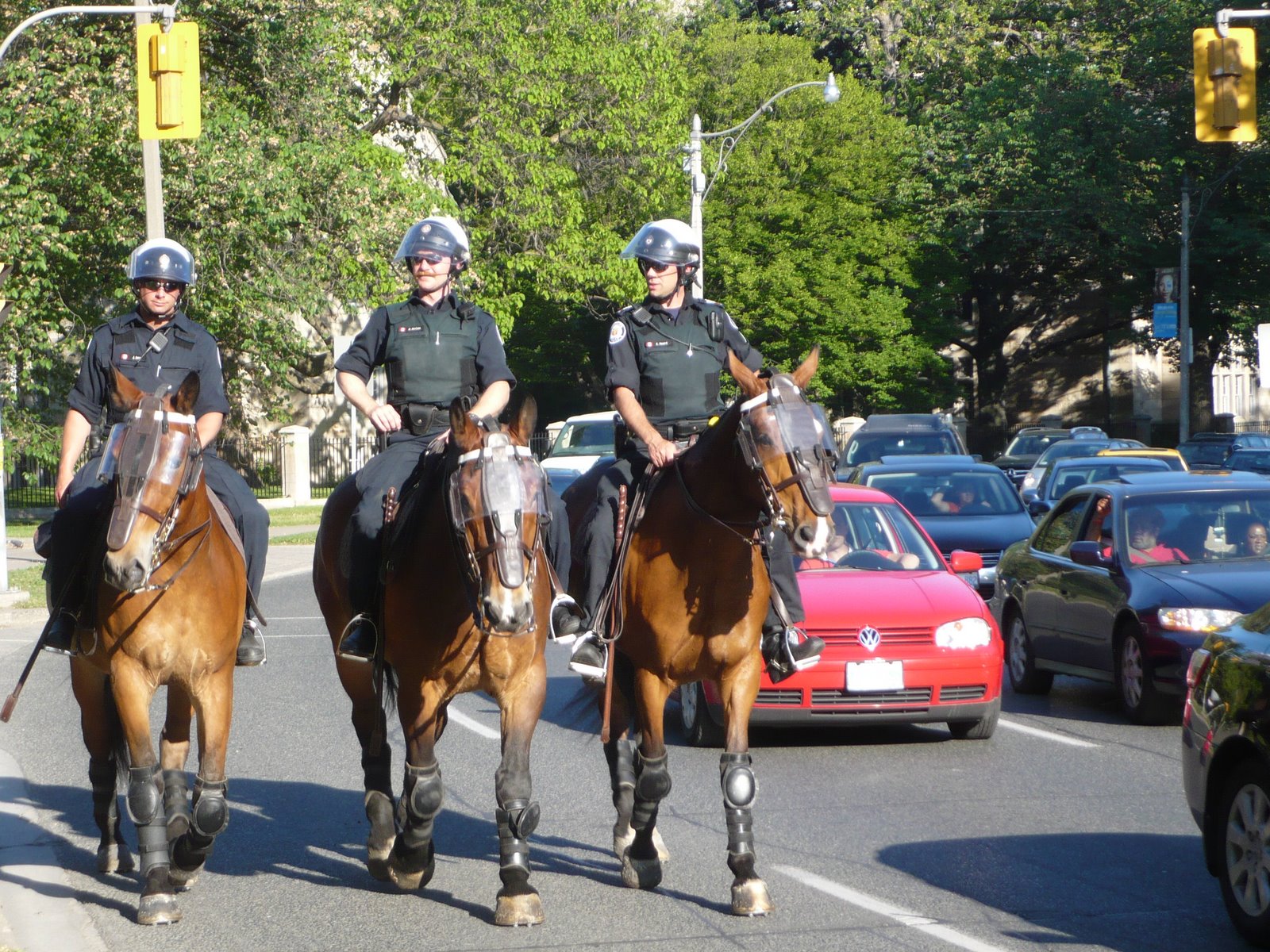
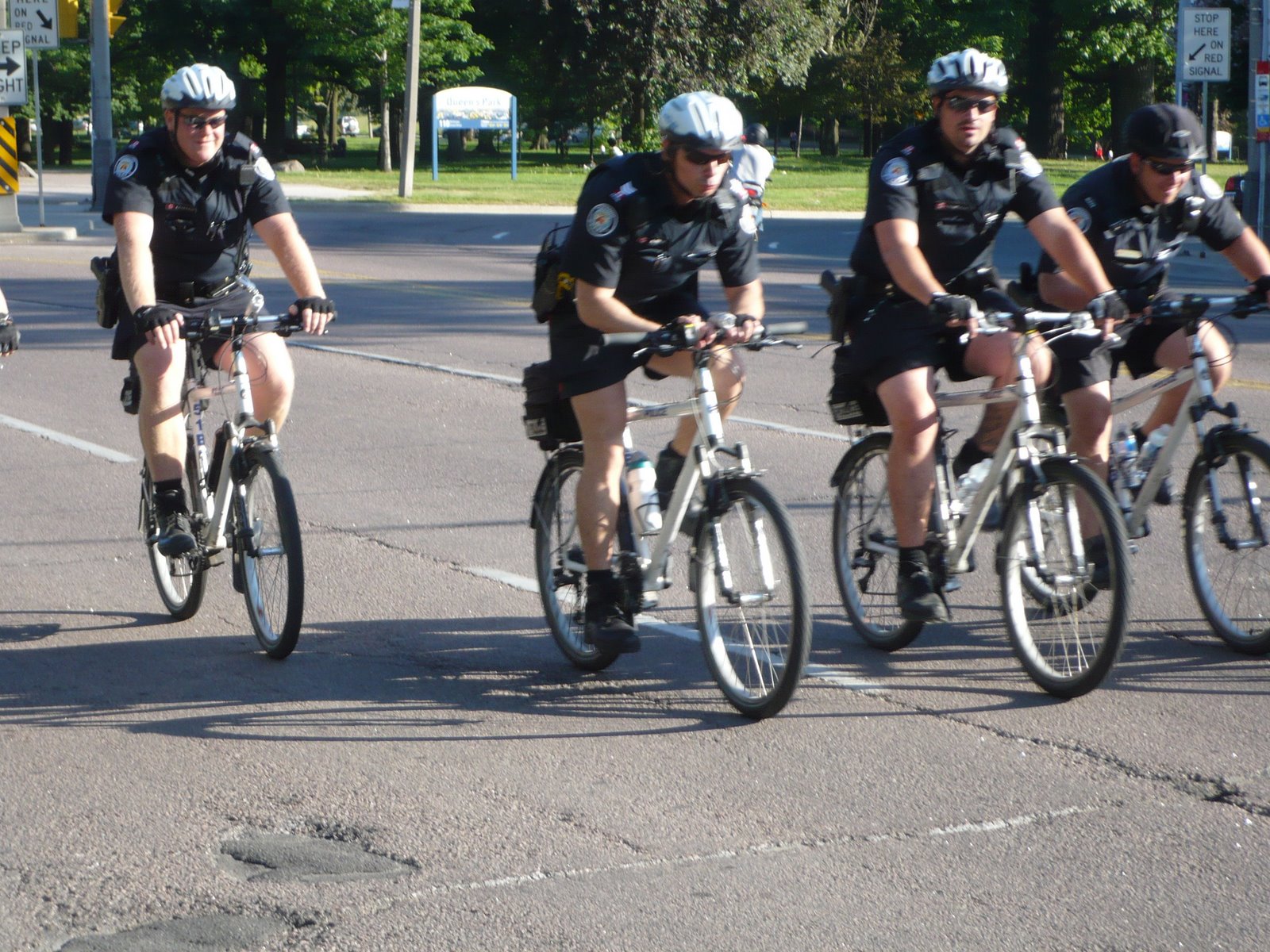
Police partout, justice nulle part -meaning police everywhere, justice nowhere- is often heard during protests in France. There are indeed a lot of police in french towns, in train stations, subways, roads, intersections. In Toronto however, police is nowhere to be seen. There are so, so, so many rules -no trespassing, no loitering, no smoking, no left turn, no crossing, no parking, no U turn, no skating, no swimming, no soliciting, no idling, no running, no insulting, no sitting, what not- some impossible to guess if you have not been born and raised in the city, like almost all rules concerning street cars. So, so, so many rules...and no police to enforce them. Take the no phoning while driving policy. Great policy! Might actually save lifes. Might. If there was anyone actually checking what people are doing in their car. Is there a single cop in Toronto whose job is to stand on the side of the road -or even sit in his car- and look for people using their phone while driving? I have never seen one. Take the no insulting TTC driver policy. What happen if you insult a TTC driver? You are filmed by a camera. And then what? The TTC guys hire a private investigator to find you? Because it they come to the police with their video tape, the response is likely to be the one my wife had when she came to report that her bike had been stolen. A huge laugh. In a city where every single building entrance is protected by a security guard, where each mall, stadium or Art gallery is patrolled by entire squadrons, who is watching the streets? Do you realize that Darcy Allan Sheppard would probably be still alive if there was a cop permanently posted at the intersection of Bay and Bloor. It has been reported that a billion dollar has been spent on the security for the G20. How many cops could patrol the street of Toronto for years with this kind of money? Isn't security a right for everyone?
Road rage
Open a newspaper these days and you'll read things like 'When the dust settles, Michael Bryant will be able to return to politics'. When the dust settles... How dare you! How can anyone write things like 'charges against him in the death of a cyclist have been withdrawn'. So Michael Bryant is Michael Bryant and not 'a yuppie in a car' while Darcy Allan Sheppard is 'a cyclist' or 'the drunk cyclist'. How about the Globe and Mail's 'Michael Bryant and Darcy Allan Sheppard:victims of circumstance'. How Bryant turned into a victim? So Darcy Allan Sheppard was drunk. And he ran after cars in the past. Now, who has never been yelled at by some drunk guy, occasionally grabing you or otherwise tried to physically impress you? Are these guys ever dangerous? No. Do you feel entitled to pull out your gun and shoot him? No. But apparently it made sense that Mr Bryant dragged this guy from Bay to University. Why? Because he was afraid. So we were told -only at the beginning of the case because after it kind of went off the radar- that Mr Bryant was a trained boxer. And he was afraid -more than afraid, apparently, in a state of panic- because he was attacked by a drunk guy. Mr Bryant was attorney general, and thus probably aware that these guys are never a danger, except for themselves and their family. And actually, at the end of the story, the cyclist dies, his family gets nothing but awful investigations about the past and the all white Mr Bryant -Brillant?- walks out free as the dove he obviously is, without a single day spent in prison, a single cent spent as retribution and is getting ready to resume a political career that was on the descending slope before the 'accident' and apparently could be reboosted because of what happened! A propos, the life of Mr Sheppard has been over-investigated, but what about the life of Mr Bryant. Who paid a detective to check if he had not an history of violent driving back in the days in BC or in Harvard. He was a boxer? That seems to be a violent sport. Was he ever involved in a fight? Why bother. Apparently, in the Ontario law system, the only past worth being investigated is the one of the victim. The real one.
Deconstruction
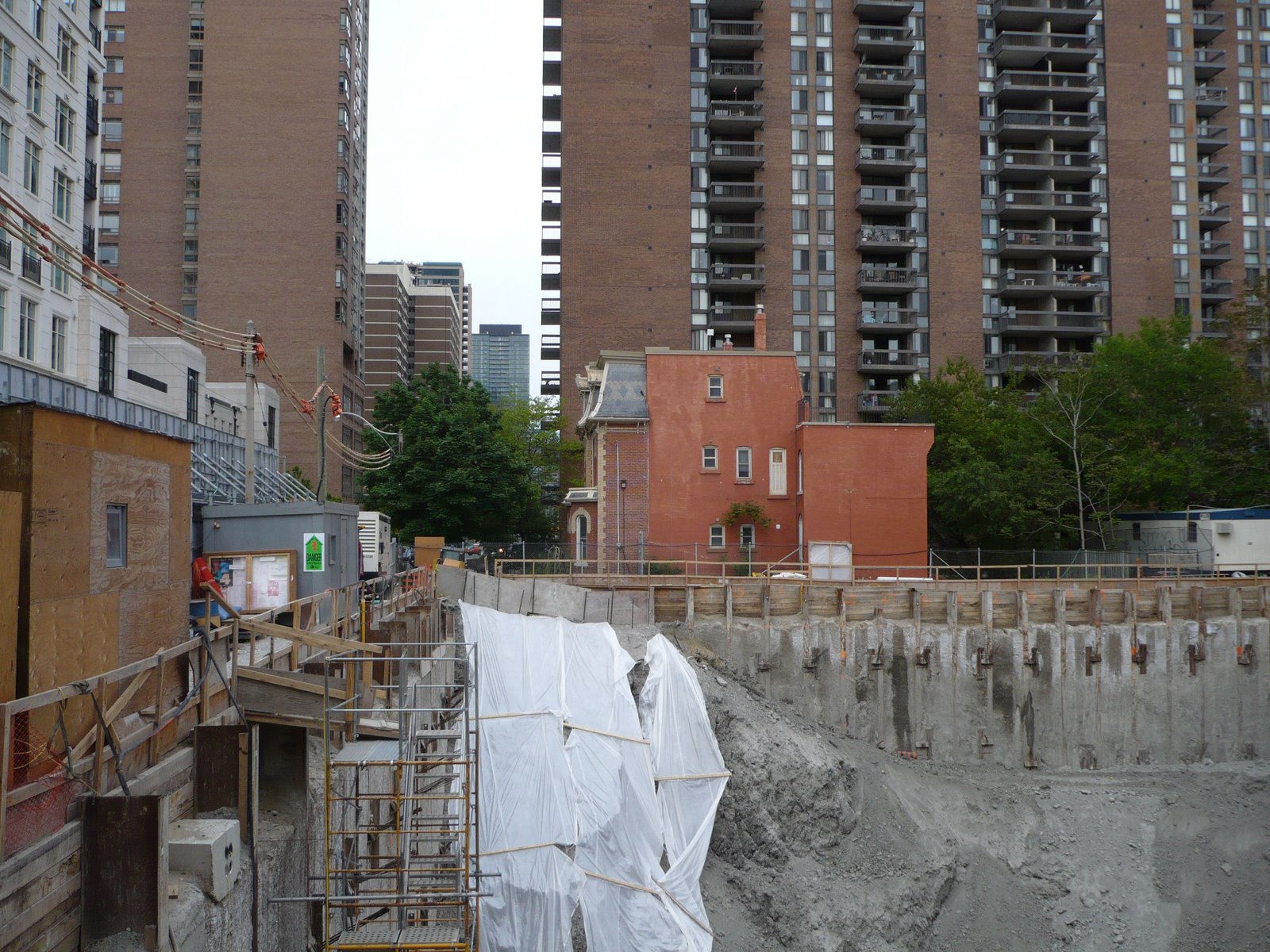
A common point between Toronto and Chicago, besides the facts that they have been both settled by french speakers, is that they are built on the shore of a great lake. The difference is that in Toronto you cannot see the lake, not even on Front street which was the shoreline of lake Ontario back in the days of Fort Rouillé. Actually, you can see the lake from a condo in a high-rise unit. Which is ironic given the fact that it is precisely because of the wild development of these condos that you cannot see the lake. Wild development does not mean a lot of construction. It means construction without any understandable logic. Except one. Private property. It is simple: if you own land, you apparently can do anything you want on it. Whatever the consequences on your neighbours, your city and your environment may be. Even on the few remaining parts of the city that are not private, like the street for exemple, anyone that owns anything anywhere in the city can do whatever he wants. Like hydro companies, or gaz companies or cable companies endlessly scarring the asphalt. Like restaurants, transforming the sidewalk in big smokers patios. Like cars using the few bike lanes available as parking space. And obviously, no-one is inclined to show their private parts. And this is how a lake disappears.
Recycled ideas
Recycling in Canada is widespread as compared to France, which may be surprising in the country of overheated giant malls, overpowered SUV and overlit high rise units. Is it because garbage is in your face while deforestation remains a distant concept in the country of the Boreal Shield ecozone? The same way throwing a stone at a dog is considered animal cruelty, while slaughtering cows for food, seals for fur and mice for convenience is deemed normal. Or is it because Canadians are good little soldiers, and recycle when they are told to do so? Or is it because they actually do not recycle and only pretend to so they have some kind of defense to raise when charged by the Global Green Prosecutor. Weak defense, I think, as I wonder if recycling makes any sense in such a big country. I was told about this community newspaper in butt fuck nowhere North of the country. They wanted their newspaper to be green, so they decided to use recycled paper. Which implied that:
A-Old newspapers are shipped, trucked, flown or sasquatch back carried to Toronto which is the nearest place with the proper recycling plant.
B-Recycled paper is shipped, trucked, flown, sasquatch back carried from Toronto to be printed in butt fuck nowhere which, by the way, has a big paper mill nearby from which paper could be almost delivered by a conveyor belt.
How many trees are equivalent to the carbon footprint of this transportation nightmare?
But it is true that I don't know for sure if recycling as a whole makes sense or not in Canada.
Does anybody knows?
Keep me posted.
Subscribe to:
Posts (Atom)